Cross-country at the 2010 Worlds, Mont-Sainte-Anne
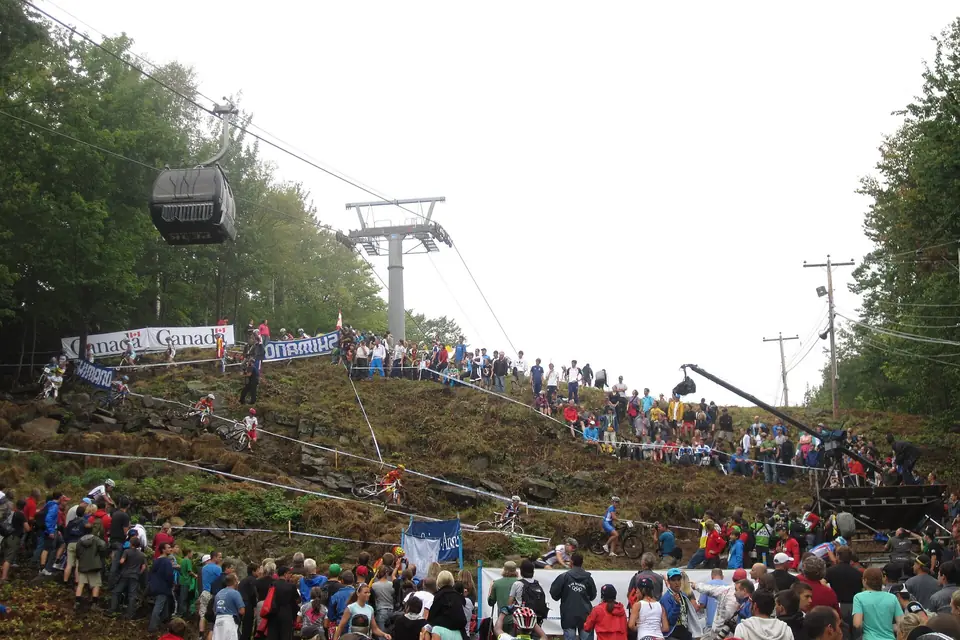
Seven cross-country world titles were decided at Mont-Sainte-Anne between 1 and 4 September 2010. This page explains how those races worked, what made the Québec course demanding, and who left with the rainbow jerseys, with links to our own short summary sheets for each race.
What "Olympic cross-country" means
Olympic cross-country (XCO) is a mass-start race on a short circuit ridden several times. Riders line up in a start grid ordered by their UCI ranking, so the best-placed athletes get a clean run into the first climb while the back rows queue. To string the field out before the first singletrack, courses often begin with a shorter start loop that is ridden once. Laps are then chosen so that the winning time lands roughly where the regulations want it; in 2010 the elite men's winner needed a little under two hours for 33 km.
The official result sheets from 2010 record the following set-up:
| Race | Day | Format | Distance |
|---|---|---|---|
| Team relay | Wed 1 Sept | 4 riders per nation | 18.4 km |
| Junior women | Wed 1 Sept | opening race | — |
| Under-23 women | Thu 2 Sept | start loop + 4 laps | 21.4 km |
| Junior men | Fri 3 Sept | start loop + 5 laps | 26.0 km |
| Under-23 men | Fri 3 Sept | start loop + 6 laps | 30.6 km |
| Elite women | Sat 4 Sept | start loop + 5 laps | 26.0 km |
| Elite men | Sat 4 Sept | start loop + 6 laps | 33.0 km |
A course that rewards bike handling
Mont-Sainte-Anne has hosted World Cup cross-country since 1991, and its reputation has hardly changed: roots, granite, steep fire-road climbs and wooded descents that turn greasy after rain. Average speeds tell the story. The elite men's winner averaged about 17.6 km/h and the elite women's winner about 14.4 km/h, well below what the same riders manage on faster European circuits. Riders who could stay smooth over wet roots, rather than simply produce power, tended to gain time lap after lap.
Elite podiums
Spain's José Antonio Hermida won the men's title ahead of Jaroslav Kulhavý of the Czech Republic and Burry Stander of South Africa. Defending champion Nino Schurter, who also took the 2010 World Cup overall, finished fourth, with France's Julien Absalon fifth. Canada's Geoff Kabush was the best home rider in eighth.
In the women's race Maja Włoszczowska of Poland beat 2009 champion Irina Kalentieva of Russia and Willow Koerber of the United States. Canada's Catharine Pendrel, the season's World Cup winner, was fourth; Marie-Hélène Prémont placed ninth.
Under-23, juniors and relay
Switzerland swept the under-23 men's podium with Mathias Flückiger, Thomas Litscher and Patrik Gallati. Sweden's Alexandra Engen won the under-23 women's race ahead of Britain's Annie Last and Poland's Paula Gorycka. The junior titles went to Michiel van der Heijden of the Netherlands and to France's Pauline Ferrand-Prévot, who repeated her 2009 win and later became an elite world champion on road and mountain bike. Switzerland also won the team relay, 18 seconds ahead of Germany.
Our summary sheets (PDF)
The links below lead to one-page summaries written by our editors: podium or top five, distance and, for the nation rankings, the rule used and the leading countries. They are not reproductions of the official result sheets; complete official results are kept by the UCI.
- Elite men, results summary · ranking by nation
- Elite women, results summary · ranking by nation
- Under-23 men · Under-23 women · U23 women by nation
- Junior men · junior men by nation
- Junior women · junior women by nation
- Team relay · Downhill junior women (filed here in 2010)
Nation rankings in brief
Each race also produced a ranking by nation, adding the points of a country's three best finishers. Spain led the elite men's table on the strength of three riders in the top ten; the United States topped the elite women's table without the winner. The host nation finished in the top three of three youth or under-23 tables, a sign of depth that would show in later seasons.
Sources
- Wikipedia, "2010 UCI Mountain Bike & Trials World Championships" (medal tables).
- UCI official result sheets for the 2010 cross-country events (communiqués 19 to 50): distances, gaps, nation rankings.
- Wikipedia, "2010 UCI Mountain Bike World Cup" (season overall standings).